In the following glossary you will find concepts related to the analysis of architecture.
Air-entrained concrete
Phrase
Air-entrained concrete contains billions of microscopic air cells per cubic foot. These air pockets relieve internal pressure on the concrete by providing.
Example: Improves concrete strength with air entrained, improves resistance to freezing and thawing exposure and to the adverse effects of deicing salts.
en: Air-entrained concrete
Architectural concrete
Phrase
Architectural concrete refers to concrete that while providing an aesthetic finish to the building also serves a structural function. Decorative concrete typically refers to concrete flatwork or building elements such as panels, that while enhanced with texture or color, are not structural building members.
Example: Hering presented a range of roofing systems, precast concrete part railway platforms and prefabricated façade solutions made of architectural concrete.
en: Architectural concrete.
Asphaltic concrete
Phrase
Asphalt Concrete is a composite material commonly used in construction of roads, highways, airports, parking lots, and many other types of pavement.
Example: To supply asphalt concrete to our plants and as well as to supply to our projects the aggregates they require for their correct operation.
en: Asphaltic concrete.
Axis
Phrase
A straight line about which a body or a geometric figure rotates or may be supposed to rotate the Earth's axis.
Example: Associated to cities which lie on it, has a coastal effect, with short reach along the horizontal axis of the water course.
en: Axis.
Backup wall
Phrase
Common interior walls (backup walls) are cold-formed steel framed walls with water-resistant sheathing and concrete masonry.
Example: Amazingly, the greatest wall in the world, the Great Wall of China, could not keep the marauders out for too long.
en: Backup wall.
Borders
Phrase
The edge or boundary of something, or the part near it.
Example: It separates from its edges, giving rise to green spaces.
en: Borders.
Brick courses
sentence
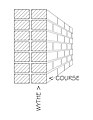
A course is a layer of the same unit running horizontally in a wall. It can also be defined as a continuous row of any masonry unit such as bricks, concrete masonry units (CMU), stone, shingles, tiles, etc.
Example: The outer walls of the building are made of stone and brick courses.
en: Brick courses
Cellular concrete
Phrase
Low-density product consisting of portland cement, cement-silica, cement-pozzolan, lime-pozzolan or lime-silica pastes, or pastes containing mixtures of these ingredients and having a structure of homogeneous cells or voids, obtained with gas - Forming chemicals or foaming agents.- ACI concrete terminology.
Example: Sale of prefabricated houses made of aerated concrete and in the planning and construction of aerated concrete production plants.
en: Cellular concrete.
Colored concrete
Phrase
Colored concrete, also known as decorative concrete, allows traditional grey concrete to be stained and dyed different colors. Concrete has been colored as far back as the early 1900s and was primarily used by companies who made precast structures for building facades.
Example: With a central passageway made of tinted prefabricated concrete slabs and two three metre wide bands of outdoor planking along the sides.
en: Colored concrete.
Concrete block
Phrase
A concrete block is one of several precast concrete products used in construction. The term precast refers to the fact that the blocks are formed and hardened.
Example: The blocks receive their final strength by means of hardening under steam pressure in the autoclaves.
en: Concrete block.
Cured concrete
Phrase
Curing of concrete is defined as providing adequate moisture, temperature, and time to allow the concrete to achieve the desired properties for its intended use.
Example: Concrete mix for hydration and the workability required for pouring leaves a dense network of passages in the matrix of the concrete, consisting of gel pores and capillary.
en: Cured concrete.
Dovetail insert
Phrase
A joint made by inserting tenon on one piece into mortise holes in the other. verb. fit together tightly, as if by means of a dovetail. type of: fit. make fit.
Example: In addition, the new WXCU 08 insert is clamped into a dovetail inclined pocket which provides very firm clamping.
en: Dovetail insert
Exposed concrete
Phrase
Exposed concrete refers to concrete whose surface is a visible part of the architectural and interior design of the building. Strictly speaking, this refers to concrete surfaces that were in contact with the formwork shell when they were produced.
Example: La estructura de muros portantes, los pilares y los forjados son de hormigón visto con encofrados de tablero fenólico.
en: Exposed concrete.
Gravity load
sentence
Gravity loads are body loads available only in Structure. These loads simulate the force of gravity as it affects your model. When you define a gravity load, you specify the gravitational components of the load in each coordinate direction.
Example: exceptionally rigid structure, supporting virtually all lateral loads (such as wind loads) and sharing the gravity load with the core columns.
en: Gravity load
Green concrete
Phrase
Green concrete is defined as a concrete which uses waste material as at least one of its components, or its production process does not lead to environmental destruction, or it has high performance and life cycle sustainability.
Example: The result is green concrete, with enhanced concrete durability.
en: Green concrete.
Hanging off (of)
noun
To leave (someone) in a difficult situation, especially in taking blame for a failure or an act of wrongdoing
Example: Also, rim joist air sealing is especially important at bump out areas such as bay windows that hang off the foundation.
en: Hanging off (of)
Horizontal mortar joints
Phrase
The straight, inclined surfaces of the bed (horizontal) joints tend to catch the light and give the brickwork a neat, ordered appearance. This joint is less compacted than the concave and V-joints, although it is still suitable for exterior building walls.
Example: LG Hausys film for textured surfaces works best if the mortar joints are not more than about 1/8 inch deep, and are flush, concave.
en: Horizontal mortar joints.
Insulating concrete
Phrase
Insulating concrete forms, or ICFs, are forms used to hold fresh concrete that remain in place permanently to provide insulation for the structure they enclose.
Example: materiales de construcción más sustentables, como nuestro concreto aislante, el cual ayuda a mitigar el calor en climas áridos.
en: Insulating concrete.
Ladder-type systems
Phrase
Ladder system means two main air lines, generally one each side of the railway tracks, cross connected at regular intervals and able to be fed from any direction.
Example: Depending on the type of stair, the supporting structure shall consist of columns or of wall bracings.
en: Ladder-type systems.
Laterally
At, toward, or from the side or sides; sideways.
Example: Both axles shall be prevented from moving sideways by means of a beam clamped to the floor against the outside of the wheel.
en: Laterally
Masonry ties
Phrase
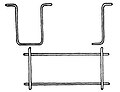
Wall ties, sometimes called 'brick ties', are used in buildings with cavity walls. They are used to join the two leaves of a cavity wall.
Example: One leg of the angle is built into the masonry and ties are passed through the post to minimise movement.
en: Masonry ties.
Metal channel
Noun
A metal channel is a roll formed metal strip that has been shaped into a tube or a U, J, or C shape for industrial and manufacturing use. Metal channels are produced by high speed roll forming that converts metal into linear roll formed channel shapes. Metal channels are used for a variety of applications.
Example: Smaller metal channel, suitable for industrial installations.
en: Canal de metal
Metal decking
Noun
In the construction industry, the term ‘metal decking’ covers all forms of the profiled steel sheeting commonly used together with concrete and steelwork to create a composite floor system or as a structural element to support a built-up roof system. The decking typically comes in two different profiles, named for their specific shapes – dovetail (or re-entrant) and trapezoidal.
Example: For anchoring into concrete ceilings, metal decking and pressed metal brackets.
en: Tarima metálica
Metal framing
Noun
Structural metal stud framing refers to the construction of walls and planes using cold-formed steel components. There are two main components of metal stud framing, a stud and a track. Heavier gauge metal studs are used in load bearing walls and structural applications such as exterior walls.
Example: Metallic structures of bars of 35 mm x 35 mm and 45 mm x 25 mm.
en: Estructura metálica.
Metal grating
Noun
Steel grating, also known as bar grating or metal grating, is an open grid assembly of metal bars, in which the bearing bars, running in one direction, are spaced by rigid attachment to cross bars running perpendicular to them or by bent connecting bars extending between them, which is designed to hold heavy loads with minimal weight. It is widely used as floors, mezzanines, stair treads, fencing, trench covers and maintenance platforms in factories, workshops, motor rooms, trolley channels, heavy loading areas, boiler equipment and heavy equipment areas, etc.
Example: In the construction of a zero slab, a metal grid is used.
en: Rejilla metálica.
Metal panel
Noun
Panels are a joinery wall cladding constructed from rigid or semi-rigid components. These are traditionally interlocking wood, but could be plastic or other materials.
Example: Metallic wall panel of different lengths, 3 meters and 1.5 meters high, with inner and outer corners of the same dimensions.
en: Panel metalico.
Metal rod
Noun
Metal rods are metals and alloys designed in the pattern of round bars or rod, rectangular or flat bars, square bars, hexagons, and other patterns of bar stock. These shapes also come in billet form and generally include a cross-section based on the shape of rod or bar stock.
Example: In this case the spine is straightened by using a metal rod, hooks, or screws in the back bones.
en: Barra de metal.
Metal roofing
Noun
A metal roof is a roof system made of metal pieces or tiles characterized by high strength, impermeability, and longevity. It is a component of the building envelope. Zinc, copper and steel alloys are commonly used.
Example: But what about other sources of heat, like the sun, which can heat metal roofing to skin-searing temperatures in just a few minutes.
en: Techo de metal.
Metal stud
Noun
Structural metal stud framing refers to the construction of walls and planes using cold-formed steel components. There are two main components of metal stud framing, a stud and a track. Heavier gauge metal studs are used in load bearing walls and structural applications such as exterior walls,
Example: Use a metal pin with a corresponding diameter or a chisel and hammer.
en: Perno de metal.
Metal tubing
Noun
Metal tube (tubing) is made of metallic elements or alloys and is designed for specific industrial applications. Compared to other types of tubing, metal tube is stronger and most robust, making it better suited for structural applications and high-pressure fluid flow.
Example: Gently insert the metal rods into the holes at the bottom of the plastic piece until resistance.
en: Tubos metálicos.
Milestone
Adjective.
An action or event marking a significant change or stage in development.
Example: Back in 2000 when TMAX was launched, it was a break through and it is certainly a milestone model in the scooter category until today.
en: Milestone.
Multi-story
sentence
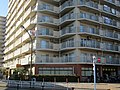
Of a building. : having more than two stories a multistory apartment building.
Example: Large numbers of multi-story apartment complexes are appearing in the vicinity of subway stations and other public services and facilities.
en: Multi-story
Node
Adject
A point at which lines or pathways intersect or branch; a central or connecting point.
Example: Barranquilla is the hub of convergence of 5 submarine cable systems that connect directly with its metropolitan optic-fiber.
en: Node
Plot
Phrase
Weft is understood as the uniform repetition of certain elements in two directions, for facades or floors.
Example: A grid of dots will configure walls, floors and ceilings.
en: Plot.
Porous concrete
Phrase
Pervious concrete is made using large aggregates with little to no fine aggregates.
Example: Porous concrete that allows rainwater to filter into the ground, reducing flooding and helping to maintain groundwater levels.
en: Porous concrete.
Precast concrete
Phrase
Precast concrete is a construction product produced by casting concrete in a reusable mold or "form" which is then cured in a controlled environment.
en: Precast concrete.
Prestressed concrete
Phrase
Prestressed concrete is a form of concrete used in construction. It is substantially "prestressed" (compressed) during production.
Example: The main advantage of prestressed-concrete sleepers is their flexibility.
en: Prestressed concrete.
Reinforced concrete.
Phrase
Reinforced concrete, concrete in which steel is embedded in such a manner that the two materials act together in resisting forces.
Example: Se garantiza mayor durabilidad que cualquier estructura de hormigón armado, con mejor comportamiento ante sismos.
en: Reinforced concrete.
Relief angel
sentence
The term relief refers to a sculptural method in which the sculpted pieces are bonded to a solid background of the same material. The term relief is from the Latin verb relevo, to raise. To create a sculpture in relief is to give the impression that the sculpted material has been raised above the background plane.
Example: Use positive axial and radial rake, 45 degree corner angle, 10 degree relief angle.
en: Relief angel
Routes and circulation
Phrase
In particular, circulation routes are the pathways people take through and around buildings or urban places. Circulation is often thought of as the 'space between the spaces', having a connective function, but it can be much more than that.
Example: Circulation paths and routes must be accessible to everyone, and their surfaces should be maintained regularly, especially during the rainy season.
en: Routes and circulation
Steel angle
Noun
Steel angle is a very common type of steel shape used in construction, machine-building and many other areas. A steel angle is an L-shaped profile manufactured by section rolling mills or bending machines.
Example: One bench level 75mm x 8mm angle steel scantling bolted to steel brackets integrated into the original fibreglass bench seats.
en: Ángulo de acero.
Steel beam
Noun
A steel beam is a structural steel product that is made to support heavy loads. Steel beams come in different sizes and types, hence their different applications in the construction of structures and buildings.
Example: A large steel bracket, attached to the bridge web at the tendon fixed end, allowed for uniform distribution of prestressing.
en: Viga de acero.
Steel column
Noun
A steel column is a vertical structure member used in construction to provide essential support. They may carry loads in compression or they may transfer loads from things like beams, ceilings, floor slabs or roof slabs to floors or foundations. Steel columns may also carry bending moments near cross-section axes,
Example: The square-section, painted galvanised steel pole allows a single or double mounting, for heights of between 4 and 8 metres.
en: Columna de acero.
Steel framing
Noun
Steel framing is an industrialized construction system based on the use of light steel structural profiles, together with other insulation, division, fixing and finishing components.
Example: The body is built around a sturdy steel structure for durability and rollover protection.
en: Estructura de acero.
Steel joist
Noun
Steel joist means an open web, secondary load-carrying member of 144 feet (43.9 m) or less, designed by the manufacturer, used for the support of floors and roofs. This does not include structural steel trusses or cold-formed joists.
Example: There may be a steel beam beneath the platform intended for lift mounting.
en: Vigueta de acero.
Steel member
Noun
Structural member - support that is a constituent part of any structure or building. beam - long thick piece of wood or metal or concrete, etc., used in construction. bracing, brace - a structural member used to stiffen a framework.
Example: Both T-pieces are connected to each other, and to the front and rear sub-frames by a 25mm diameter steel tension member,
en: Niembro de acero-
Steel plate
Noun
Steel Plate, or structural steel is simply steel sheet material that can be customarily cut and welded to develop a more elaborate product. It is made by compressing multiple steel layers together into one; forming a plate of steel.
Example: If a protruding member would present an inadequate area for the weight, a steel plate of appropriate thickness and depth and about 300 mm in.
en: Placa de acero.
Steel reinforcement
Noun
Rebar, also known as reinforcement steel and reinforcing steel, is a steel bar or mesh of steel wires used in reinforced concrete and masonry structures to strengthen and hold the concrete in tension.
Example: The continuous steel reinforcement with a thickness of up to 3 mm ensures excellent stability and secure fixing of fittings.
en: Refuerzo de acero.
Steel reinforcing
Noun
Rebar, also known as reinforcement steel and reinforcing steel, is a steel bar or mesh of steel wires used in reinforced concrete and masonry structures to strengthen and hold the concrete in tension.
Example: Electrowelded wire mesh is a prefabricated reinforcement product made from smooth or ribbed cold-drawn reinforcing steel wires joined together by right-angle spot welding to form a network.
en: Refuerzo de acero.
Steel rod
Noun
Steel rods, called rebars, placed in the lower portion of a concrete slab prevent that slab from cracking when subjected to that tensile bending force.
Example: Chrome rectangular steel bar construction.
en: Barra de acero.
Steel sections
Noun
Steel sections are the bread and butter of steel fabrication. Designers, architects and engineers choose different sections for their aesthetics and structural qualities – their choices determined by size, weight and profile. Steel is extremely versatile and can be moulded to many different shapes.
Example: The base plate is assembled from steel sections and is of an open design so that it can be grouted into concrete.
en: Secciones de acero.
Supports
verb
bear all or part of the weight of; hold up.
Example: the dome was supported by a hundred white columns.
en: Supports
Tie (something) back to
verb
Example: Safely secure tie-back plate to a concrete structure on roof and loop other end of tie-back cable over shackle and secure with three.
en: Tie (something) back to
Transfers
Verb
to cause to pass from one to another.
Example: made of masonry, reinforced concrete, steel or concrete, which transfers the loads that support a structure to the subsoil.
en: Transfers
Unreinforced concrete
Phrase
In this book, author Katrin Hanses presents readers with a comprehensive guide to essential knowledge regarding the properties of concrete, how it is produced,
Example: Liquid frost protection material for cold weather and to increase early strengths of non-reinforced concrete, masonry mortar as well as screeds.
en: Unreinforced concrete.
Urban legibility
Phrase
Legibility is one of the principles of urban design. Legibility means the possibility of organizing an environment within an imageable and coherent pattern.
Example: Comala has great urban readability.
en: Urban legibility.
Wedge anchor
sentence
"Wedge anchor" is a generic term for a type of anchor used to fasten a variety of materials to concrete. Some companies have different brand names for their wedge anchors such as Kwik Bolt, Power Stud, and Thunderstud.
Example: The Tie Wire wedge anchor is designed primarily for suspended ceiling installation.